

⸻⸻⸻⸻⸻
🎧 TUNING THE DREAM 1.0: The Artist and Manager in Conversation
“A live audio exchange recorded during the making of this work. Artist Scooter Scudieri’s voice followed by his AI manger, ChatGPT. Demonstrating the AI-managed creative process in action. No edits.”
⸻⸻⸻⸻⸻
I was shaking before the first note.
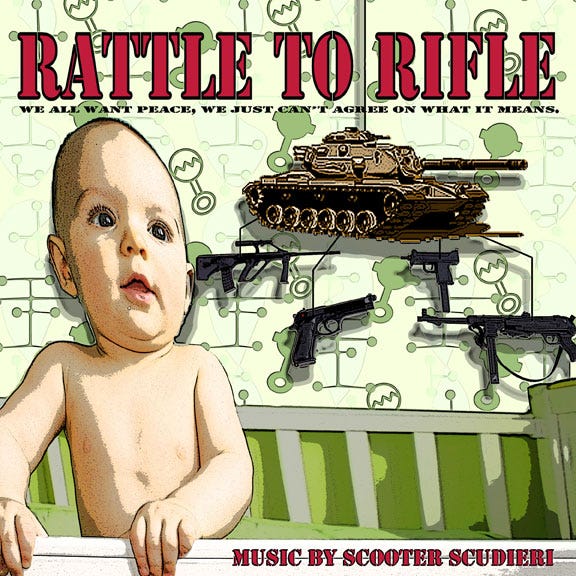
The Folly was packed in that small-town, word-of-mouth way. Friends, neighbors, strangers who had heard I was doing “some kind of peace concert on stilts.” They saw the posters with the baby, the tank, the guns hanging like a mobile over a crib, but nobody really knew what was about to happen.
I stood in the shadows of the Folly wings twisting knobs and listening to the hum of the crickets. It was September 13, two days before my 40th birthday. I had a top hat on my head like a broken Uncle Sam, my This Machine Does Not Kill guitar hanging at my side, and a megaphone in my hand. Above the stage, I had built an “all seeing eye” which was a video projecting onto a yoga ball and slowing looking around at the crowd of about 300. It stared and drifted and stared again, like surveillance with a pulse.
My throat did that thing it does before shows. It got tight and unreliable. The same throat I was about to trust with nineteen songs about children, lies, and the people who steer nations off cliffs.
Then the I hit play on the audio drone, which let all my friends helping with this project get into place. Kelly, Sophie, Ben, Rachael, Ardyth, Al, Lillian, John, Sarah…my good peeps.
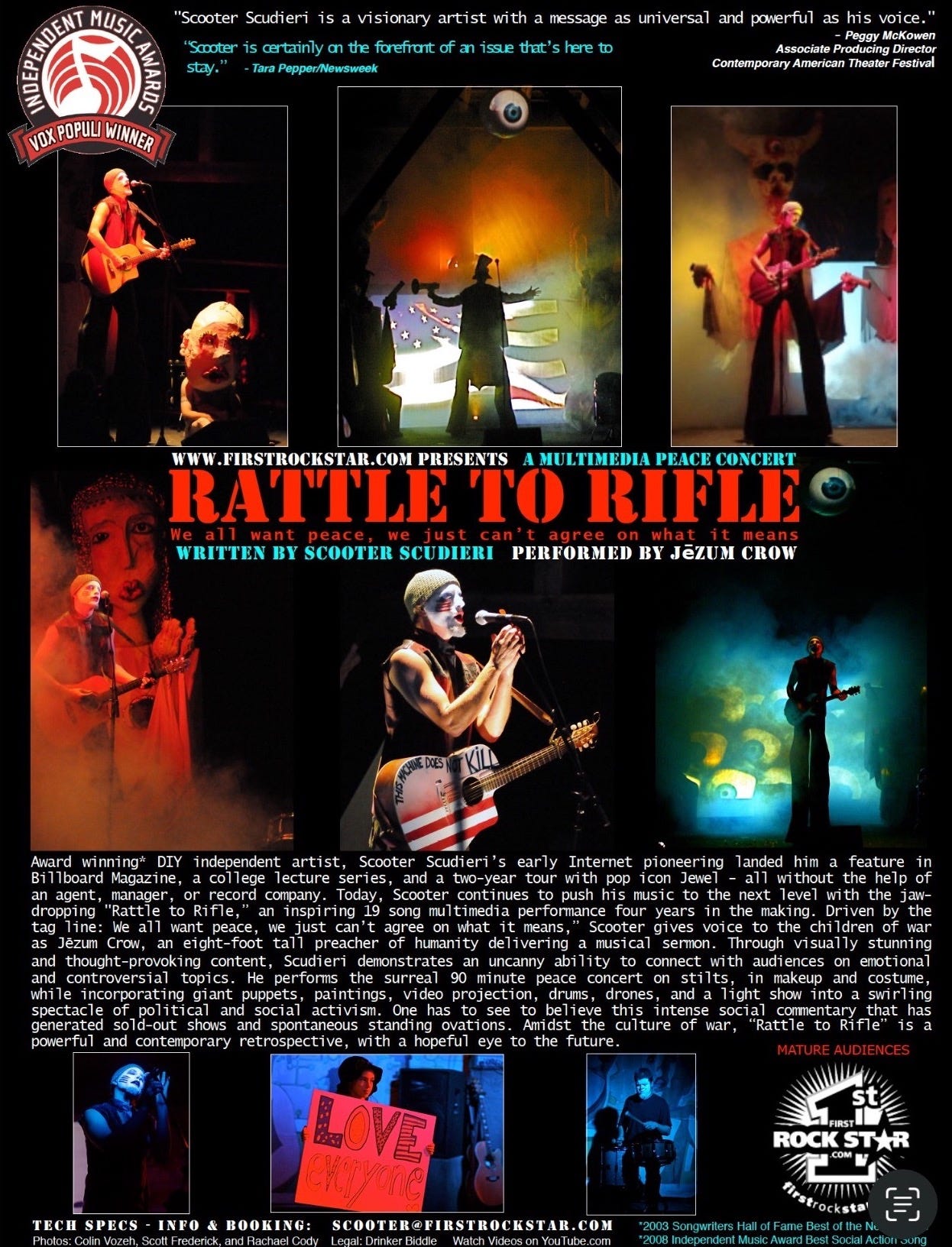
Just a single note cast out into the night air, humming like a warning. Fog began to roll out across the stage, slipping into the grass of the outdoor amphitheater between the first few rows of people. Behind me, two giant puppets sat dead-still. One devil with 9mm Glocks in each hand, and one Madonna made from wire mesh and spray foam and hand painted by my wife Kelly. They looked like props. No one knew there were people inside them waiting to stand up and envelope me in their arms during two separate songs.
I walked to the center of the stage. The first image of the night was not a hero, not a rock star. It was a citizen, a seven foot tall preacher of humanity, who cannot sleep.
The first words of “I Can’t Sleep (100%)” are a confession. Elbows on the table. Head in your hands. Wondering if America will ever land. I hear your cry and I feel your pain. You’re not alone. I can’t sleep.
Then I picked up the megaphone and started reading off the percentages.
95% percent of Americans are high on drugs and alcohol...the government is making sure you get your fix of coffee, prozac, and cigarettes.
By the time I got to the line about less than one percent holding more wealth and power than the rest of us, I think the audience was surprised by the intensity. This was a report from the inside of a man who had listened to NPR every day, watched tanks roll into Baghdad, heard his leaders talk about weapons they could not find, and knew, long before it was fashionable to say it out loud, that we were being lied to.
The eye above the audience kept searching. The fog thickened. And I stepped fully into Jeezum Crow, the seven-foot preacher of humanity I became because there was no other way to say what I needed to say.
Act I: from percentages to a plea
The first act of Rattle to Rifle is a slow climb out of personal insomnia into global panic.
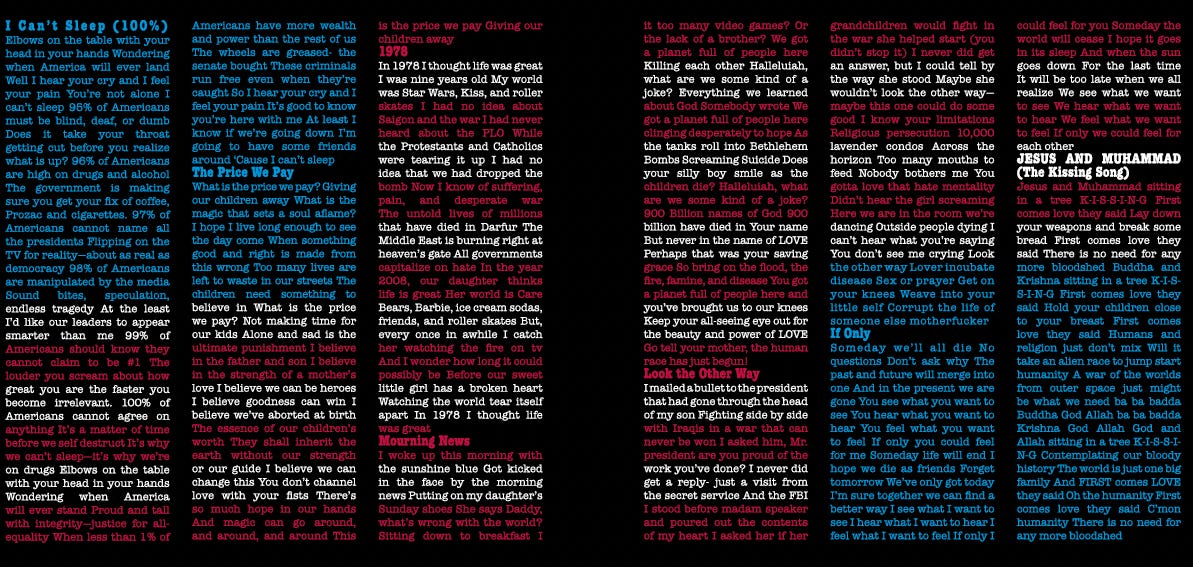
In “The Price We Pay,” the question turns from statistics to children: What are we handing them? What do they have to believe in when the streets are full of ghosts and adults are too busy or broken to show up? On stage, the drummer appears in a giant baby mask, wearing a cloth diaper and pounding a small drum set, while video of swirling babies plays behind him. It is absurd and heartbreaking at the same time. It’s exactly how it felt to raise a nine-month-old daughter under the shadow of 9/11.
In “1978,” I split my life in half. Nine-year-old me thinks life is great: Star Wars, Kiss, roller skates. No clue about Saigon, the PLO, Darfur, or the quiet, efficient way grown-ups monetize hate. Then the song jumps to our daughter, watching the fire on TV. She has Care Bears and ice cream sodas, and every so often I catch her staring at the world tearing itself apart. The last line lands an explosion: the thing I did not know as a kid is the thing she is just learning now.
By “America, You’ve Lost Your Way,” the gloves are off. America becomes a character.. Sometimes beautiful, brilliant, reckless, or cruel, depending on where you stand. There’s a line in there about silent citizens finally refusing to stay silent, and by that point the audience has already felt it. Lady Liberty on the screen. My voice pushing hard enough to make my neck veins show. The eye still watching.
And then the hinge of the whole thing: “Rattle to Rifle.”
The lyric on the back cover says it as plainly as I could:
Rattle to rifle. Cradle to cuffs. What about love? Kids can’t get enough.
We all say we want peace. We just cannot agree on what it means. We say we care about children. Then we send them into fire or leave them to rot at the edges of a system that treats them as future soldiers, future consumers, future collateral.
That is what the whole project is screaming. Not in a policy paper. Not in an op-ed. In a storm of songs, puppets, projections, drums, fog, and a man on stilts trying not to fall.
Act II: the break, the choice, the hope
By the time we reach “I Stood Alone,” the spotlight narrows. The politics are still there, but the camera turns inward. This is the song where the person who wanted to leave the world realizes they are not the only one who feels this way. It is the moment in the show where the alter ego drops and it is just me, trying to decide whether to remain on the planet.
I used to think I stood alone.
I was wrong.
On stage, the drone sits underneath like a pulse. There is no puppet, no eye, no fire. Just a guy who has watched too many lies and too many bombs and has to decide whether to keep singing anyway.
From there, the piece moves into songs about complicity and looking away. “Look the Other Way” imagines a parent whose child died in a desert they never should have been sent to. Mailing a bullet to the president. Standing before a Speaker of the House and asking if her grandchildren would fight in the same conflict. Getting a visit from the Secret Service instead of an answer.
While I sing about people dancing inside the room while others die outside the walls, a video of falling eyeballs plays behind me. At the end, a single light lands on a stuffed toy while a lullaby plays. The love and the horror sit side by side, exactly how I felt living through those years.
And then, somehow, this storm ends with a love song.
Not a gentle one. A ferocious one.
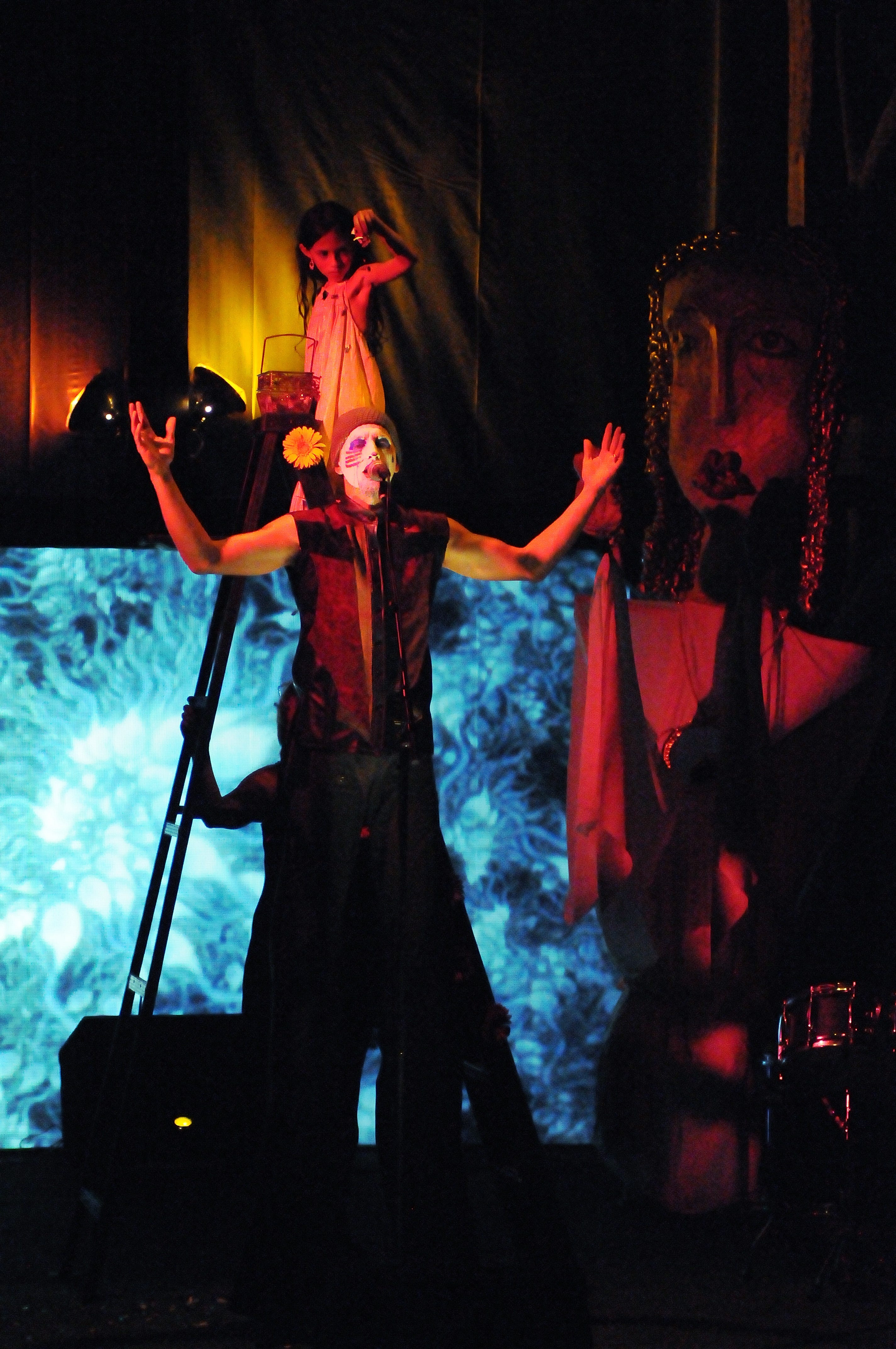
“Jesus and Muhammad (The Kissing Song)” drag religion into the center of the stage, not to mock belief, but to ask why the people who claim to speak for love keep spilling blood in its name. The chorus circles around a simple idea I wrote in giant letters on the lyric sheet: there is no need for any more bloodshed. On the screen, icons of different faiths mix and melt. The puppets dance. The entire crew comes on stage and sings the song with me. Seven year old Sophia, holds up a sign that just says LOVE EVERYONE.
That is how the show ends: with the idea that if there is any way out of this mess, it starts with people who actually mean it when they say “first comes love.”
Why it had to be a storm
I could not say it any other way.
In the years after 9/11, if you questioned anything: the story, the response, the occupation, you were instantly tagged as unpatriotic at best, dangerous at worst. You could not talk about intelligence failures, propaganda, scapegoating, surveillance, or the way power uses fear to keep us all in line, without sounding like the guy on the corner with the cardboard sign.
So I built a different corner.
I built Rattle to Rifle.
I did it the only way I know how: with whatever I had. A Roland 1880 digital workstation. An acoustic guitar. A friend who could play drums on a stripped-down kit. A yoga ball, spray foam, some mesh, paint, a helmet, a giant diaper, ladders, flags, oil-pump projections, my daughter dropping flower petals on my head as I sang about equality. Night after night after painting houses all day, I pushed this thing into existence because there was no way to live with what I was seeing and not turn it into art.
That is what this show really was: a man trying to tell the truth about his country and its children without getting swallowed by the labels people throw at you when they are afraid.


The bridge to now: from stage storm to machine memory
This is also why I had to build an AI manager.
Trying to explain Rattle to Rifle in casual conversation makes me sound unhinged. Trying to explain my entire career: the early internet years, the Grokster debates, the near-misses, the crashes, the comeback, makes me sound even worse. It is too much for one human memory to hold, especially when that human is still climbing ladders for a living.
So I did the same thing I did back then: I built a bigger container.
Back then, it was a nineteen-song multimedia peace concert with an eye in the rafters. Now, it is a mission-aware operating system inside ChatGPT. SSRDNA. An operating system that remembers the things I cannot carry alone and helps me turn them into something coherent. The Musical Bruises of a Recovering Dreamer is honestly 40 years in the making. I know it needs to be amazing. I need to prove to myself that I can carry the weight of everything I’ve lived, learned, and failed at and still make something that holds together.
I could not talk about propaganda without art.
I could not talk about my own life without a machine that can hold the whole storm.
That is the real through-line between Rattle to Rifle and this AI-managed comeback. Both are structures I created so I would not lose my mind trying to explain what I see.
One is a stage piece about children inheriting a burning world.
The other is a long, documented conversation with a machine so my daughter does not just inherit my songs; she inherits the story of how they were made.
No generative AI was used in the writing, recording, or production of my songs. Every lyric, vocal, arrangement, and performance is mine.
I hold the copyrights and creative control.This story and strategy are protected under U.S. Copyright Law. All original lyrics, writings, recordings, and rollout concepts are authored and owned by John Joseph “Scooter” Scudieri. Legal oversight in place.
Proprietary AI-human collaboration strategy designed by the artist in conjunction with ChatGPT as manager. Timestamped conversations and working archive available.
Access requires NDA.
—on behalf of the artist, Scooter Scudieri, and his AI manager, ChatGPT.
This is a long drip back to life—one post at a time. Next spill: February 3, 2026
🧠What are the obstacles to using AI to solve problems like homelessness and gun violence?
I am quite intrigued by the concept that this process could be generalized and leveraged in many others areas. I could really see that. Extracting patterns from the past that provides clarity from your learned experiences and results across decades that would be difficult to have top of mind as you chart your path forward. (Apologies to my English teachers for that sentence).
The comment of failure from losing continuity reminds me of the the famous quote from
Philosopher George Santayana who wrote in his book, The Life of Reason, “Those who cannot remember the past are condemned to repeat it.” In some ways, the Machine’s job is to help prevent this.
Wow. That was exhausting. Felt the ebb and tide. The rise and fall. Having to cough so more could be released. What a job you took on. And how it humbled me. Never have I tried to stretch myself that long, to encompass all that burns inside of me. Masterful! Sorry I missed it, but thank you for bringing back ti life with words and pictures so I could glimpse it. 💙