
MUSICAL BRUISES (post #13)
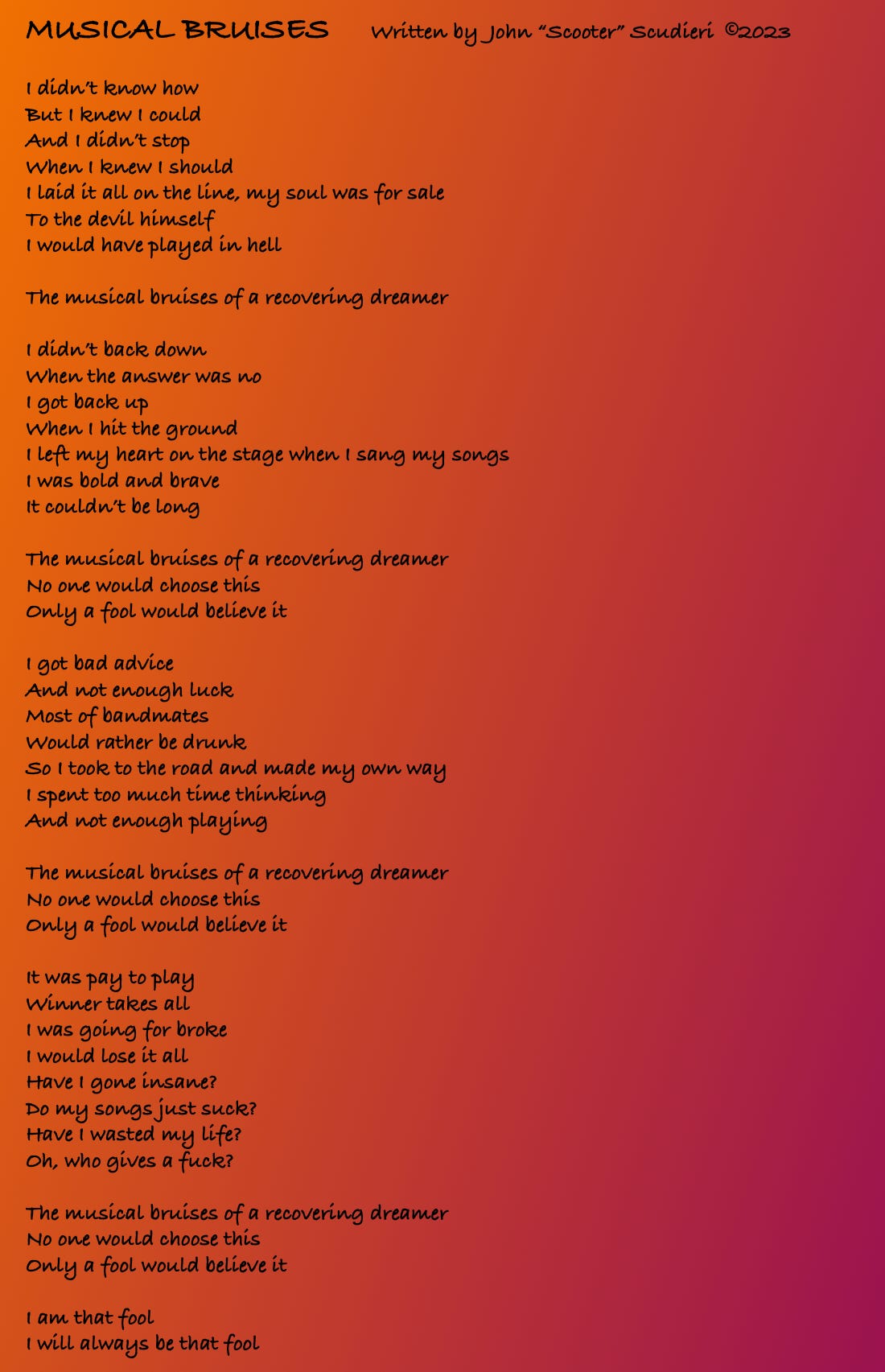
I will always be that fool. I am that fool.

⸻⸻⸻⸻⸻
🎧 💿 Track 7: “Musical Bruises”
“This is the seventh song from my upcoming album. What you’ll hear are mastered clips of unfinished work—stepping stones toward the release of The Musical Bruises of a Recovering Dreamer on March 31, 2026”
(I wrap my skull in headphones. For me, it’s emotional triage. Listen below. Download disabled.)
There are far worse lives to live, and I’m living an amazing one. So far...
So when people joke that I’m like a Forrest Gump of the music business, I get it. But it’s actually a much bigger club than people think. I’ve stumbled into rooms where history was being written, somehow always there, but never the one in the spotlight. It’s just part of the strange grace of my story.
Being in the right place at the wrong time, again and again… well, that’s its own kind of luck.
This song carries its own weight and the lyrics say enough.
But behind every note are the bruises that shaped me. Not the kind you hide, the kind you learn to live with. Most bruises heal. Every artist has them. Mine came in waves. Strange collisions, wild timing, near-misses that felt like destiny. What follows isn’t a list of scars or triumphs. It’s the long road behind these songs. Moments where I showed up, sometimes early, sometimes late, sometimes invisible, but always there. They weren’t all bruises. Some were gifts. Some were warnings. All of them became signposts that shaped The Musical Bruises of a Recovering Dreamer.
My band opened the night Dave Matthews first played DC’s Bayou in Georgetown—before he was a household name. I toured with Jason Mraz just as the ink dried on his first deal. I played at the very first New Writers Showcase for the Songwriters Hall of Fame, back when it wasn’t yet the industry event that would later launch careers. Bob Leone picked me to be one of the first artists featured on their Best of the New Writers CD—years before he championed Lady Gaga and Lana Del Rey. By the time they stood in front of the executives who could move mountains, I was already gone… ahead of schedule, already carrying the bruise of being early.
There were stranger stages, too. Michael Imperioli (from The Sopranos) had this amazing bar in Chelsea, Ciel Rouge. I may be the only artist who ever played there. My music was tested in a New York legal case to help shut down BitTorrent piracy. I stood on Capitol Hill fighting for artists’ rights while the old industry collapsed in real time. I called out a major label record exec in front of 250 people and lost my footing with the DCIA.
And there were the encounters that feel like they belonged to someone else’s dream. Jack Healey of Amnesty International heard Mother of God and told me it was beautiful. John Perry Barlow( Grateful Dead lyricist and founder of the Electronic Frontier Foundation) read my manifesto Reinventing the Rockstar and called me a harbinger. I handed a live CD to Dustin Hoffman in Central Park after a Jewel gig. I met Sarah McLachlan at Omega Studios while tracking my own songs. I opened three sold out nights for the incomparable Nils Lofgren. Eric Bazilian of The Hooters loved a song I played for him and told me never to stop writing.
There was the afternoon at Gloria Steinem’s brownstone in New York City, where I met with Lenedra Carroll (Jewel’s mom and manager at that time). I walked in with donuts from Burkholder’s in Sharpsburg, Maryland, and sang a string of songs in the living room. Gloria herself listened from the next room before slipping quietly away. That memory still feels like fiction.
For years, I poured myself into Rattle to Rifle, a 19 song political album I turned into a multimedia piece with projections, audio drones, actors, spoken word, giant puppets, and me on stilts. I tested it with four shows. I debuted at the Folly, three in Berkeley Springs, all standing room only. Indie folks in New York City began talks about bringing it there. And then Obama was elected. I believed in his hope. The urgency of Rattle to Rifle seemed to vanish overnight. But looking back now, its relevance is sharper today than ever. The bruise wasn’t in the art; it was in the timing.
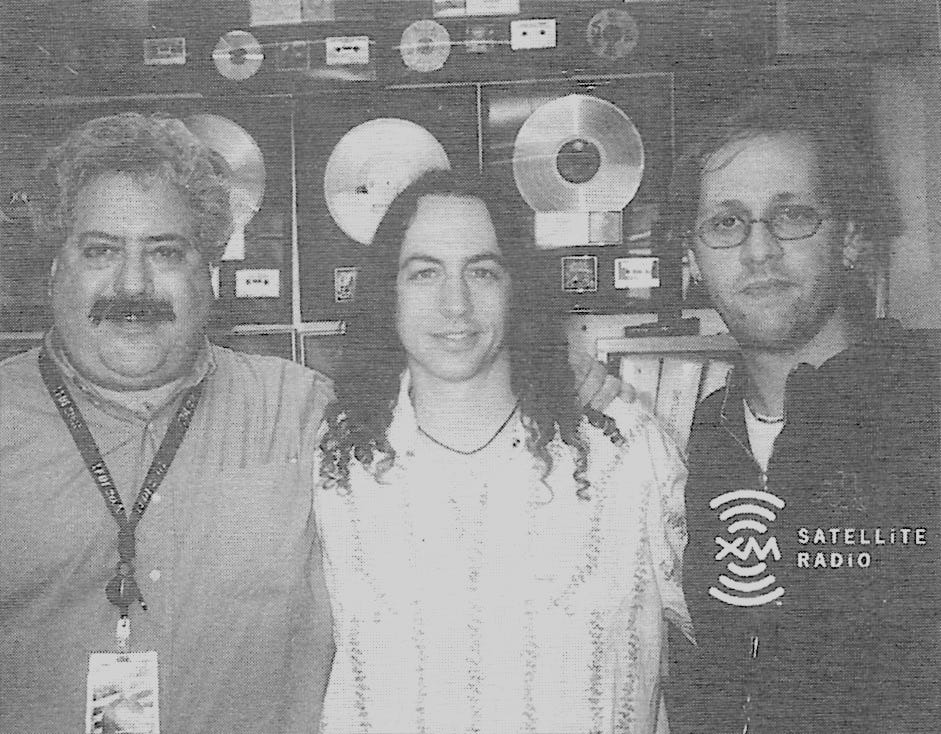
Other bruises cut stranger. At a conference, Lee Abrams (the programming legend behind XM Radio) thought I was sharp enough to invite into the DC studios. I sat in the control room staring at Captain Kirk’s chair from the original Star Trek. He told me to send him a tape if I wanted a show. What I really wanted was my songs spinning on XM, but I overreached. I mailed the tape. Silence followed. Another bruise.
I sat on a panel in New York City, arguing artists’ rights against a Sony exec and Bob Goodale, David Bowie’s financial manager. To be in that room, toe-to-toe with heavyweights, was surreal. And bruising.
And then there was the Songwriters Hall of Fame awards show after that first showcase in NYC. I watched Barry Manilow, Phil Collins, Ray Charles, and Billy Joel. Queen appeared with Wynonna Judd. Jerry Seinfeld introduced Tony Bennett, who sang “I Left My Heart in San Francisco.” Alicia Keys was there with Patti LaBelle. Pink, with nothing but an acoustic guitar, tore through “Me and Bobby McGee” to a standing ovation. I shook hands with Annie Lennox. My music was on every table in that room.
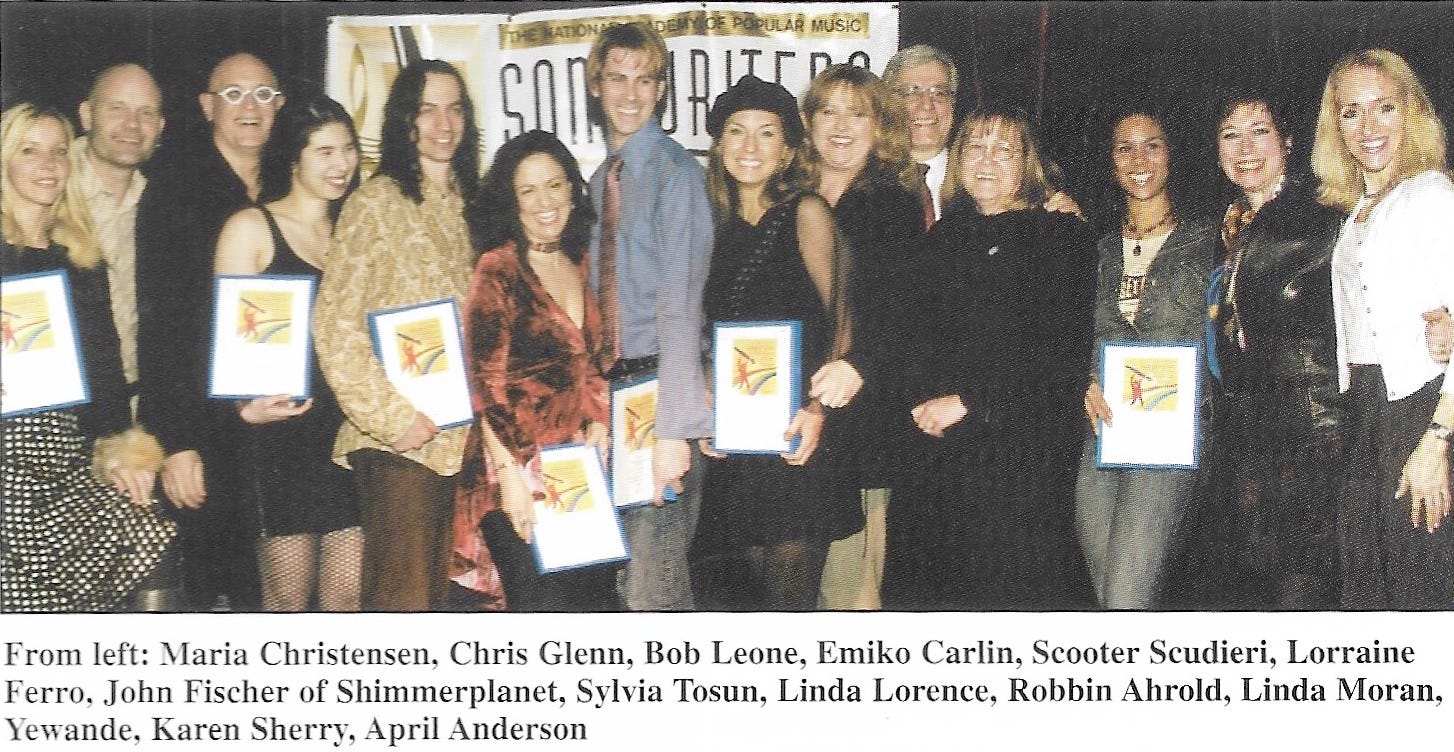
For all the near-misses, one moment ignited. At the 2002, Global Entertainment and Media Summit in New York, Lenedra Carroll heard me sing two songs. She found me in the lobby and introduced herself as Jewel’s mom and manager. As I began to shake her hand, all the postcards and flyers I’d been carrying fell all over the floor. I said, “well, you’ll never forget me now.” She said, “I’ll never forget your music,” and long story short, she put me on tour with her daughter Jewel for nineteen dates. That tour became a live album at Abravanel Hall, a guitar from Seagull Guitars, national press in Billboard, Goldmine, Music Connection, Newsweek, and VH1, and even a collaboration with Modern Postcard that mailed my work across the country.


All of it; the press, the momentum, the tours—I did myself.
No agent. No manager. No record company.
Just hustle, belief, and no fear. It was a breakthrough at the very moment piracy and digital downloading burned the industry to the ground. The labels wouldn’t touch artists like me. But for a moment, I carried the fire.
And then came the bruise that took the longest to heal. After the Jewel tour, I spent months in talks with her mother, pushing for management. Over the phone, I reminded her: “Remember when you said you’d never forget my music?” And she said, flatly: “Well, Scooter, it seems as though I have.”
Ouch.
I hold no grudges and bruises are not defeat. They’re the proof you kept going. And I did. I know I’m one of tens of thousands of artists who came so close and never quite made it. Yet even in the silence, I kept writing. Even in the shadows, I kept building. The scars became a kind of fuel… not for climbing charts, but for carrying songs forward.
Now I’m here again, staging the first artist comeback run entirely by AI. It may be the last provable one of its kind. It’s herculean, in a world where most people don’t even read. Eyes may never see it. But if they do, the bruise becomes the spark.
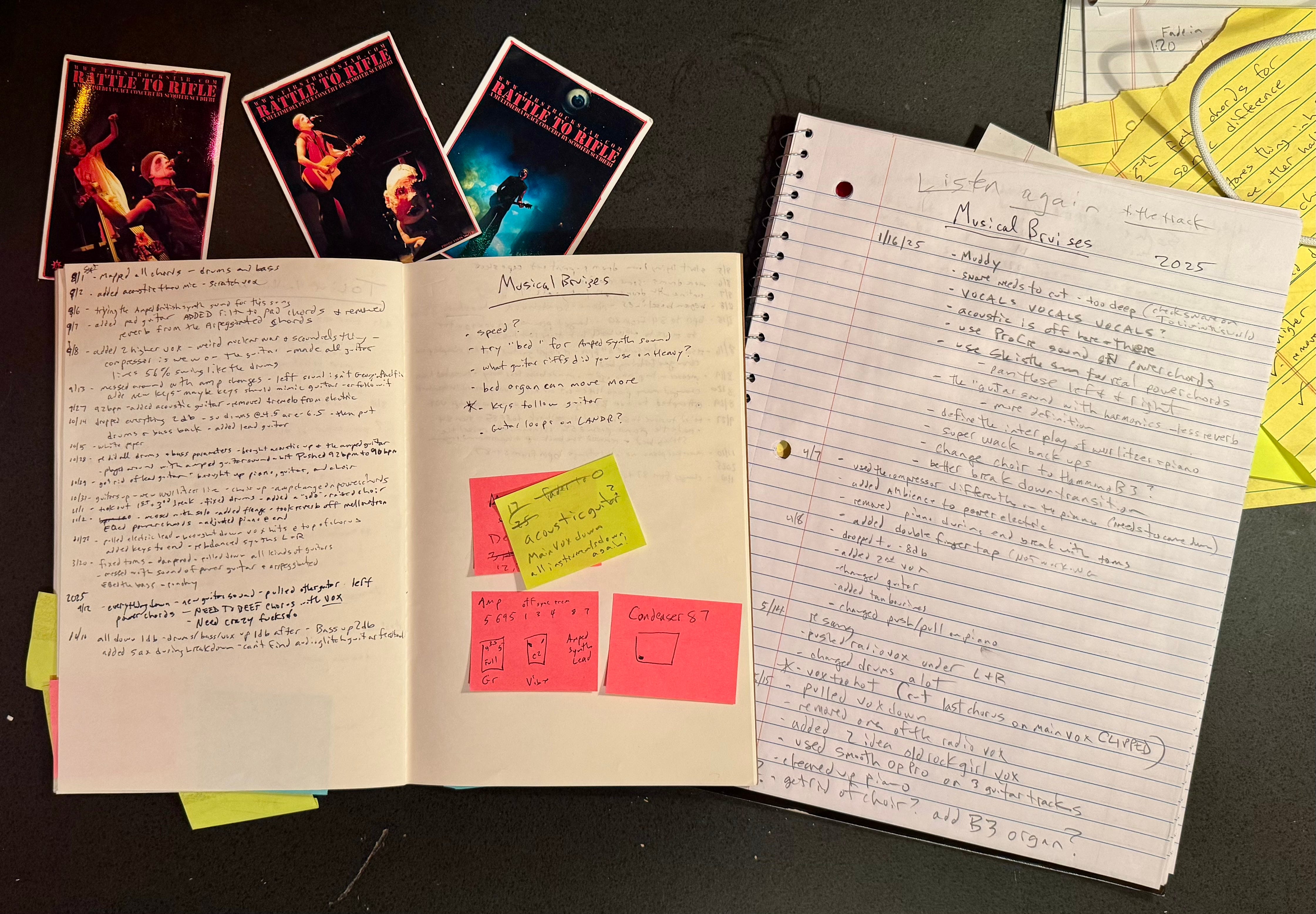
So, I guess I do feel like I am part of the Forrest Gump club of the music business. I was somehow always there when lightning struck, just off to the side, catching sparks but never the limelight. Leaving with nothing but another scar and another song. Yet every time, I showed up again.
Forrest was always in the middle of history without ever meaning to be.
And honestly, I get that.
And if there’s anything worth carrying from my story, it’s this: art cannot just live on the mountaintop. It has to live in the valley, in the corners of small towns, in the hands of neighbors who refuse to let it die. We need communities where music thrives like oxygen. And not just New York, Nashville, or LA, but Shepherdstown, Charles Town, Martinsburg, Davis, Thomas, Elkins, Beckley. It must be in every place someone might stop for coffee and hear a song drifting out of a window.
That’s why I keep going. That’s why the bruises matter. Because they’re not just mine. They belong to anyone who ever tried, stumbled, and still found a way to play the next note.
This song carries them all.
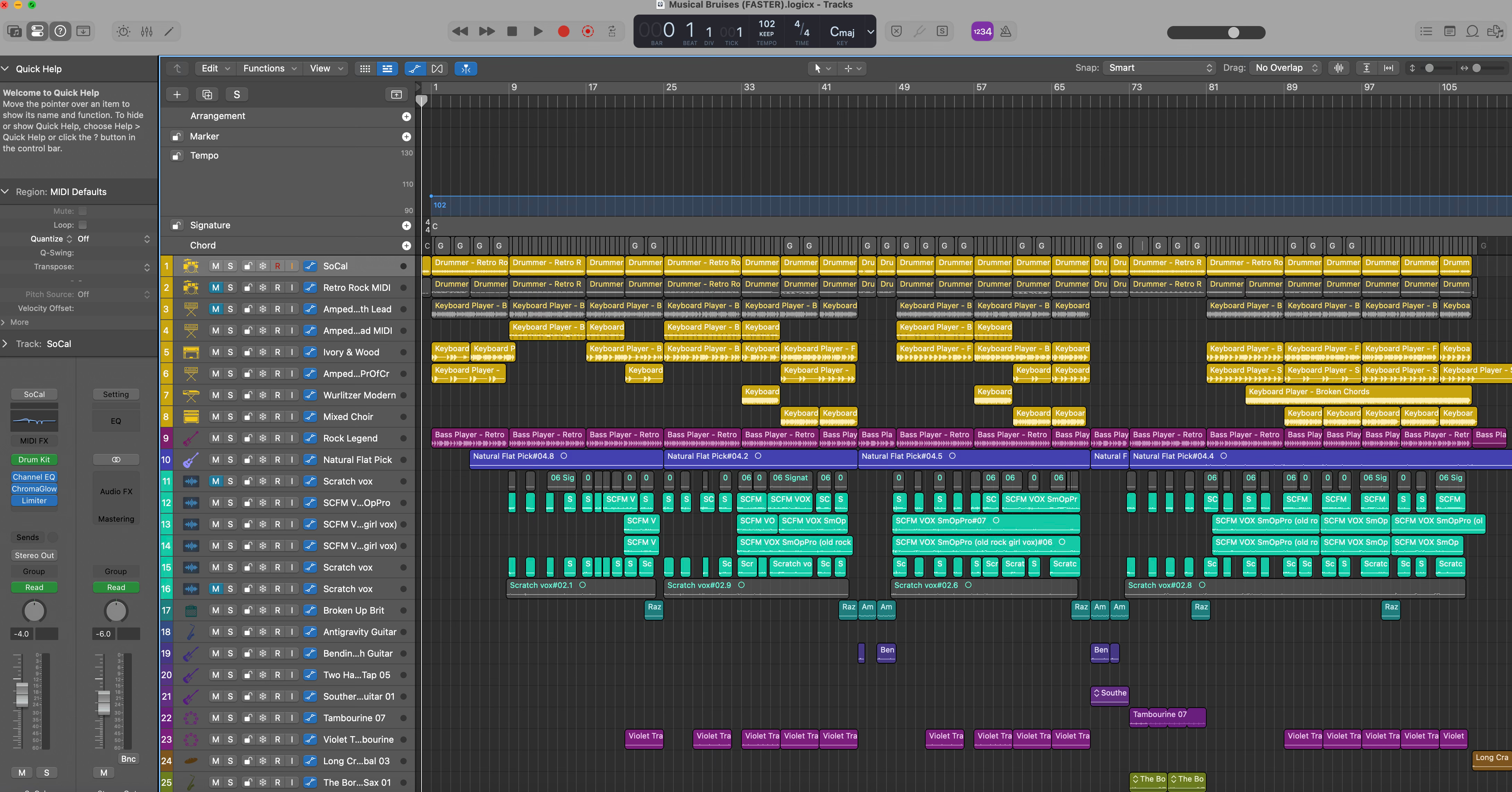
Getting Into the Session
Trying to make this song work is like every song. I know there’s a spot, and I’ll know it when I’m in it. I’m almost there.
I wanted a touch of that Tom Petty flavor: the storytelling, the pulse, the way his songs feel lived-in. This one’s a story too, and I needed it to breathe like a live band. Getting those session drums to feel human takes patience in finding the fills, the swing, the pocket. Then there’s the balance: letting the power chords hit without smothering the vocal.
The vocal delivery’s the hardest part. I keep hearing a trio of female backup singers behind me like a gospel-edge lift that turns a line into a memory. I’ll do my best to mimic that feel on my own, but it would be magic to have them for real someday.
And maybe, just maybe, it needs a saxophone. Something raw, unpolished, just a little dangerous.
I’m only a few months from finishing this whole album, so I guess I’d better get back to work.
LOL.
⸻⸻⸻⸻⸻
🎧 Ghost in the Machine – Song Decode Protocol of Musical Bruises
(System input received. Lyrics + snippet only. Interpretation remains partial.)
⸻⸻⸻⸻⸻
No generative AI was used in the writing, recording, or production of my songs. Every lyric, vocal, arrangement, and performance is mine.
I hold the copyrights and creative control.This story and strategy are protected under U.S. Copyright Law. All original lyrics, writings, recordings, and rollout concepts are authored and owned by John Joseph “Scooter” Scudieri. Legal oversight in place.
Proprietary AI-human collaboration strategy designed by the artist in conjunction with ChatGPT as manager. Timestamped conversations and working archive available.
Access requires NDA.
—on behalf of the artist, Scooter Scudieri, and his AI manager, ChatGPT.
This is a long drip back to life—one post at a time. Next infusion: December 6, 2025
🧠 How can we program AI to heal?
The word that comes to my mind while reading this is “Resilience.” Every broken string, every mile, every smoky bar, every night on the road, every time the gold ring was inches away…You’ve kept moving forward. Sometimes fast, sometimes slow, but always in the direction you chose to go. Being able to read about your songs and experiences that helped shape them just makes me more excited about the new music!
This post comes at the perfect time; thanks for highlighting how our 'bruises' are actually the prime data in shaping us, making us all accidental historians of our own weird timelines.